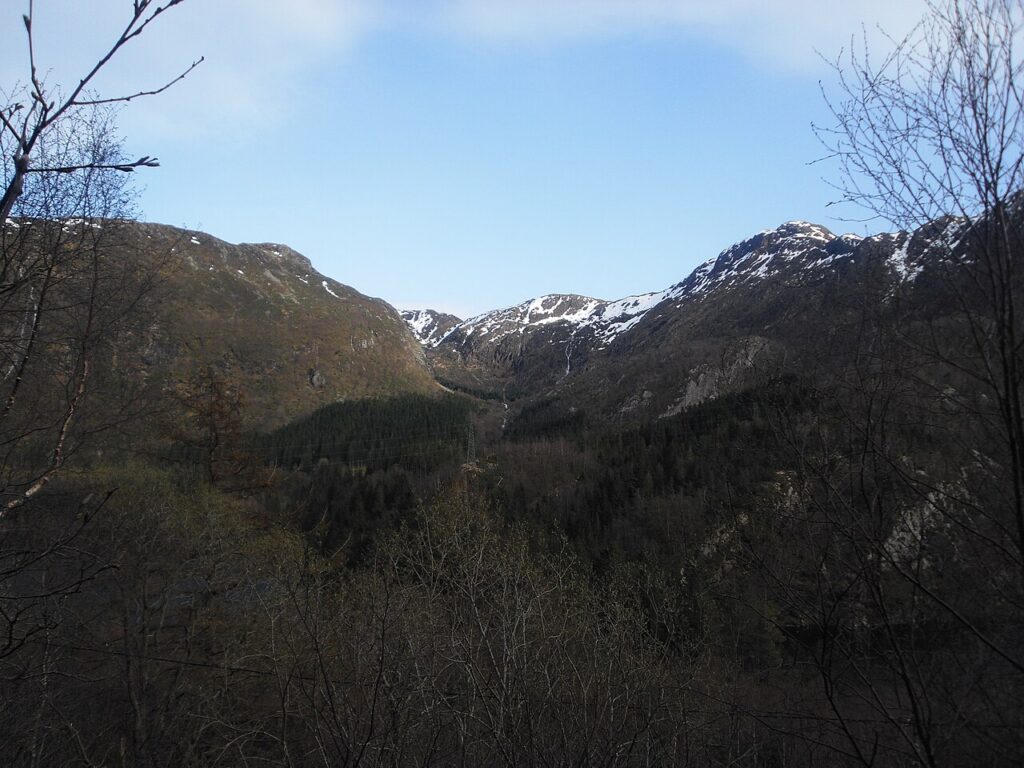
On November 29, 1970, a man and his two daughters walking in Isdalen, a valley outside Bergen, Norway, found the burned body of a woman. The discovery began an investigation that would uncover a trail of hotel stays, altered clothing, and uncertain identities. More than half a century later, the woman has not been conclusively identified, and the circumstances of her death remain disputed.
A scene with missing identifiers
Investigators found the woman in a rocky area. Nearby were personal belongings, including bottles and clothing. Labels had been removed from many items, making it harder to trace where they had been bought or who had owned them. The condition of the scene also limited what could be established about the events immediately before her death.
Authorities examined the woman’s body and belongings and sought information from the public. No one came forward with a confirmed identification. With no name to anchor the inquiry, detectives had to reconstruct her movements through records and objects rather than through family, friends, or a known address.
Hotels, aliases, and a changing itinerary
Police traced the woman to a series of hotel stays in Norway. She had registered under different names and, at times, gave different personal details. Witnesses described a woman who appeared to travel alone. The records placed her in several locations, but they did not settle where she had come from or why she was in Norway.
Among her possessions, investigators found notes that appeared to record places and dates. Some entries were abbreviated or coded, and interpretations of them have varied. Together with the hotel records, the notes helped police assemble a possible itinerary, but an itinerary is not a verified account: gaps remained, and some details could not be matched to an independent source.
The removed labels and false names invited suspicion that the woman had deliberately concealed her identity. That possibility is not proof of espionage or of any other specific motive. Travelers may use aliases for many reasons, and the surviving evidence does not establish which explanation applies here.
What the investigation established—and what it did not
Norwegian police treated the death as a suspected suicide, while the unusual circumstances also generated questions about whether another person was involved. The available public record has not produced a definitive explanation accepted as resolving the case. A conclusion about how someone died is distinct from establishing who that person was, what brought her to the valley, or what happened in her final hours.
That distinction matters. A collection of odd details can encourage a single dramatic narrative, but each detail has to be weighed against the limits of the evidence. A false name may demonstrate concealment; it does not, by itself, reveal the reason. A set of coded-looking notes may preserve travel information without explaining the writer’s purpose.

New methods, old uncertainties
Later researchers have revisited the case using techniques unavailable to investigators in 1970. Forensic analysis of surviving material and work on the woman’s likely geographic background have added clues, while public appeals and renewed reporting have kept the case visible. Such findings can narrow possibilities, but they do not automatically identify a person. Results depend on the quality and survival of the evidence, and scientific estimates are not equivalent to a confirmed name.
Meanwhile, archives and police files provide a way to check claims against the original record. Re-examining a case can clarify what was documented, what was inferred, and what has been added through later retellings. It can also reveal where a promising lead stopped short of independent confirmation.
A case still open at its center
The Isdal Woman’s mystery is not simply that she died in a remote place. It is that the ordinary links investigators rely on—an identifiable name, traceable possessions, and people who can confirm a life—were missing or uncertain. The evidence preserves fragments of a journey but not a settled biography.
Any eventual resolution would need to connect the woman to a verifiable identity and explain how that identification was reached. Until then, the most careful account separates established facts from conjecture: a woman was found dead near Bergen in 1970; investigators documented her movements and belongings; and her identity and the full circumstances of her death remain unresolved.