When OpenAI launched ChatGPT in late 2022, it transformed conversational artificial intelligence from an academic curiosity into an accessible everyday tool. Within weeks, millions of individuals and organizations began testing its capacity to write code, synthesize complex research, compose creative drafts, and converse with human-like fluency. Today, ChatGPT stands as the benchmark for generative pre-trained transformers, igniting intense competition and accelerating digital transformation across global enterprises.
The Core Architecture: Transformers and Alignment
At the center of ChatGPT’s capabilities is the generative pre-trained transformer architecture. Unlike earlier sequential language models, transformers process entire sequences of text simultaneously through self-attention mechanisms. This allows the model to capture subtle contextual nuances, long-range dependencies, and semantic relationships across vast bodies of unstructured text.
However, raw pre-training alone merely teaches a model to predict the next token in a sequence. The decisive breakthrough behind ChatGPT was the integration of human-guided alignment techniques, most notably Reinforcement Learning from Human Feedback (RLHF). Through RLHF, human annotators evaluated and ranked model responses, guiding an optimization algorithm to favor answers that are informative, coherent, and safe while penalizing hallucinations, toxicity, or deceptive outputs.

Multimodal Evolution: Beyond Textual Interaction
While the initial release of ChatGPT operated strictly as a text-in, text-out chatbot, the system quickly evolved into a multifaceted assistant. Subsequent model iterations expanded its perceptual capabilities to encompass vision, audio, and analytical data processing:
- Vision Understanding: Users can upload diagrams, UI mockups, handwritten notes, or code screenshots for instant interpretation, debugging, and translation into digital formats.
- Native Voice Interfaces: Low-latency audio processing allows near-instant conversational exchanges with natural cadence, intonation, and contextual pacing.
- Advanced Data Analysis: The platform can execute Python code in secure sandbox environments to process datasets, generate interactive statistical charts, and clean complex files automatically.
This multimodal integration marks a fundamental shift from simple text querying toward proactive problem-solving, turning the platform into an interactive workspace rather than a basic text generator.
Real-World Adoption and Industry Impact
The practical utility of ChatGPT spans nearly every knowledge-intensive discipline. Rather than replacing human specialists outright, the tool predominantly functions as a cognitive accelerator, augmenting productivity across multiple sectors.
Software Engineering
In software development, programmers routinely use ChatGPT to draft boilerplate code, refactor legacy functions, write unit tests, and resolve obscure runtime exceptions. By serving as an interactive documentation search engine and pair-programming assistant, it substantially reduces the cognitive friction of navigating modern software stacks.
Education and Research
Educators and researchers leverage conversational models to generate customized learning materials, simplify technical abstractions, and synthesize literature. While academic integrity remains a topic of scrutiny, many forward-looking institutions have transitioned from outright bans to instructing students on responsible prompt engineering and critical verification.
Enterprise Operations and Customer Service
Enterprises integrate specialized API instances into internal customer relationship management systems and customer support funnels. By handling first-tier inquiries, summarizing inbound communications, and generating draft correspondence, organizations maintain round-the-clock responsiveness while freeing human agents to resolve high-friction escalations.
Critical Challenges: Accuracy, Privacy, and Governance
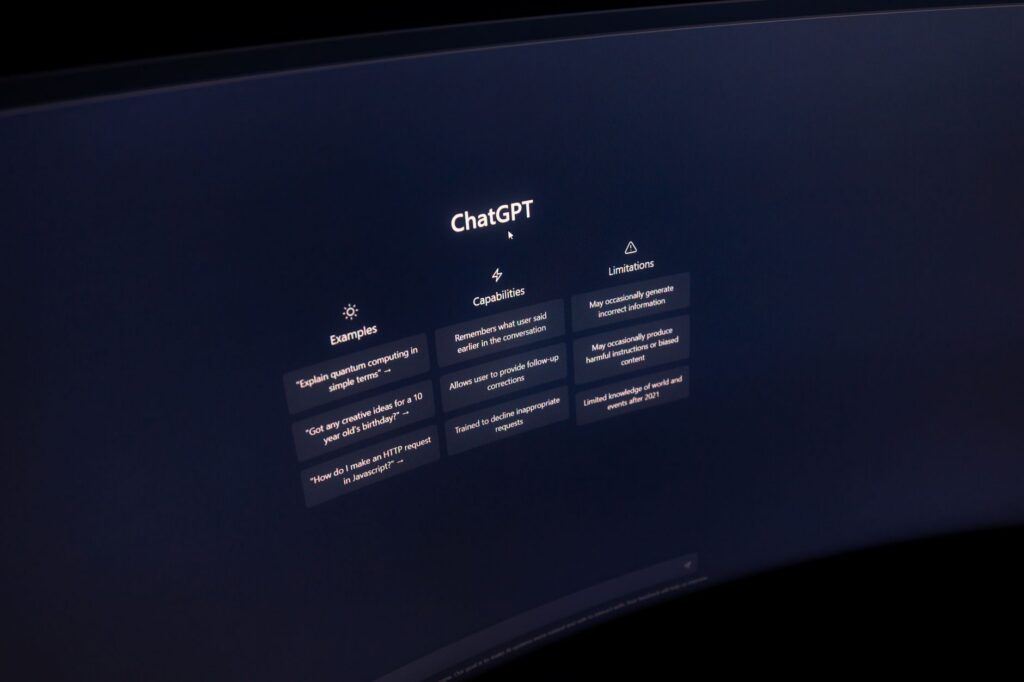
Despite its capabilities, widespread adoption of ChatGPT has exposed significant technological and societal vulnerabilities. Addressing these limitations is essential for sustainable implementation:
“A generative model does not possess factual understanding; it possesses probabilistic coherence. Distinguishing between confident expression and verifiable truth remains a primary responsibility of the user.”
The primary concern remains algorithmic hallucination—instances where the model fabricates plausible-sounding but entirely inaccurate facts, citations, or references. In regulated domains such as law, finance, and healthcare, unverified reliance on model output carries substantial legal and operational risk.
Furthermore, data privacy and intellectual property considerations have prompted strict compliance policies. Enterprise leaders frequently confront questions regarding whether proprietary trade secrets or sensitive user prompts could inadvertently inform future training iterations. While commercial agreements now frequently guarantee data isolation, building lasting organizational trust remains an ongoing process.
Conclusion: Navigating the Next Horizon
ChatGPT represents more than a sophisticated conversational interface; it serves as the vanguard of a broader generative AI revolution. As models become more reliable, context windows expand, and autonomous agent frameworks mature, the metric of success will shift from conversational novelty to measurable utility. Embracing this technology requires a balanced approach—one that harnesses its immense productivity gains while maintaining rigorous human oversight, ethical governance, and factual scrutiny.