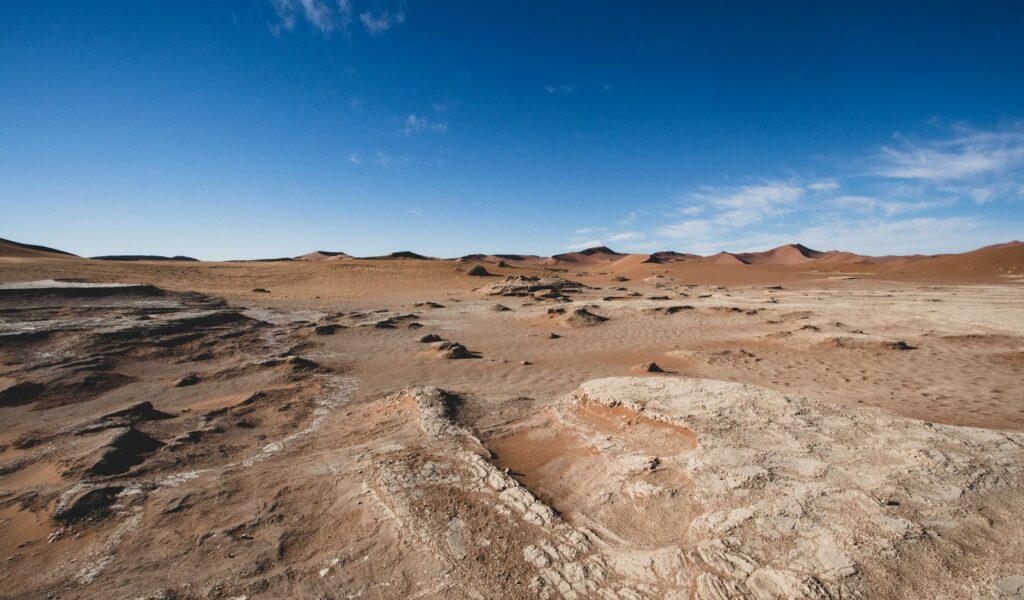
In parts of Namibia’s dry grasslands, circular patches of bare ground interrupt the surrounding vegetation. Known as fairy circles, they can appear in repeated patterns across broad areas, creating a landscape that looks carefully arranged from above. The circles are not painted or excavated by people, and their regularity has made them a long-running puzzle for ecologists.
Each patch is generally surrounded by taller grass, while its center contains little or no vegetation. Their sizes and spacing vary, and they are especially visible in open, arid country. The pattern is striking, but appearance alone does not explain how the circles form or why they occur in some places and not others.
Why dry ground can form a pattern
Water is scarce in the Namib, and grasses compete for it. One leading explanation is that plants growing near one another draw moisture from the soil, leaving the centers of some spaces too dry to support new growth. If vegetation at the edges can access water more effectively, a bare center may persist while grasses around it survive.
In this account, the circles are not isolated oddities but part of a system shaped by competition and feedback. A patch of bare soil may collect rainwater differently from a grass-covered area. The surrounding plants can then influence where water is absorbed and how far it travels through the soil. Repeated across a landscape, these interactions may produce regularly spaced gaps.
Models of vegetation in dry environments can generate patterns resembling fairy circles. That is useful evidence that plant-and-water interactions could create the phenomenon, but a model is not a direct record of what happened at every real circle. The same general pattern may emerge through different combinations of rainfall, soil, plant growth, and local conditions.
The termite hypothesis
Another explanation focuses on sand termites. Termite activity can alter soil and vegetation, and researchers have found termite nests in or near some circles. The insects might remove grass, change how water moves through the ground, or help maintain bare patches during dry periods.
Finding termites is not, by itself, proof that they created the circles. Insects may occupy a patch after it forms, or they may contribute to its maintenance without being responsible for its initial appearance. Researchers also have to distinguish active termite effects from the wider influence of drought and soil conditions, which can produce similar signs.
The debate is not necessarily a choice between termites and vegetation. Biological activity and water competition could both matter, with their relative importance changing from site to site. Establishing that relationship requires observations over time, not just a snapshot of a circle and its surroundings.
Namibia’s Unsolved Fairy Circles
What evidence would settle the question?
A convincing explanation needs to account for several features at once: the bare centers, the grass around the edges, the repeated spacing, and the persistence of the pattern. It should also explain why circles occur in particular landscapes and how they change as conditions shift.
That calls for measurements of soil moisture, vegetation, rainfall, and insect activity both inside and outside the patches. Repeated surveys can show whether a circle expands, contracts, or fills with grass over time. Comparisons among sites can help researchers determine whether the same processes operate everywhere or whether different causes produce similar-looking patterns.
Experiments can add another line of evidence. For example, researchers can test how grass responds when access to water or soil conditions are altered. Such tests help isolate mechanisms, although an experiment in one location may not reproduce the full complexity of a natural landscape.
A mystery with practical stakes
Fairy circles are a scientific puzzle, but the questions reach beyond their appearance. Understanding how plants persist in very dry environments can inform research on fragile grasslands and the effects of changing rainfall. The circles offer a visible case study in how small-scale interactions may shape broad ecological patterns.
For now, the safest conclusion is that no single explanation should be treated as settled for every circle. Termites may play a role in some places, while competition among grasses for limited water may help generate or maintain the pattern. Continued fieldwork can test how these processes interact. The mystery is not that nature has made perfect circles, but that several plausible mechanisms may leave marks that look remarkably alike.