A journey with a missing ending
European eels begin life in the Atlantic and spend much of their growth in rivers, estuaries, and coastal waters. Later, they leave those habitats and travel west toward the Sargasso Sea, a region of the North Atlantic associated with their reproduction. The broad outline of this cycle is established. Its most important moments, however, remain out of direct view.
Scientists have found eel larvae in the Sargasso Sea, and tracking studies have followed migrating adults across parts of their route. Yet the exact spawning grounds, the timing of reproduction, and the behavior of adults at the destination are still hard to document. The eel’s life is therefore not an entirely unknown story, but one whose final chapter has proved unusually difficult to witness.
From river resident to ocean migrant
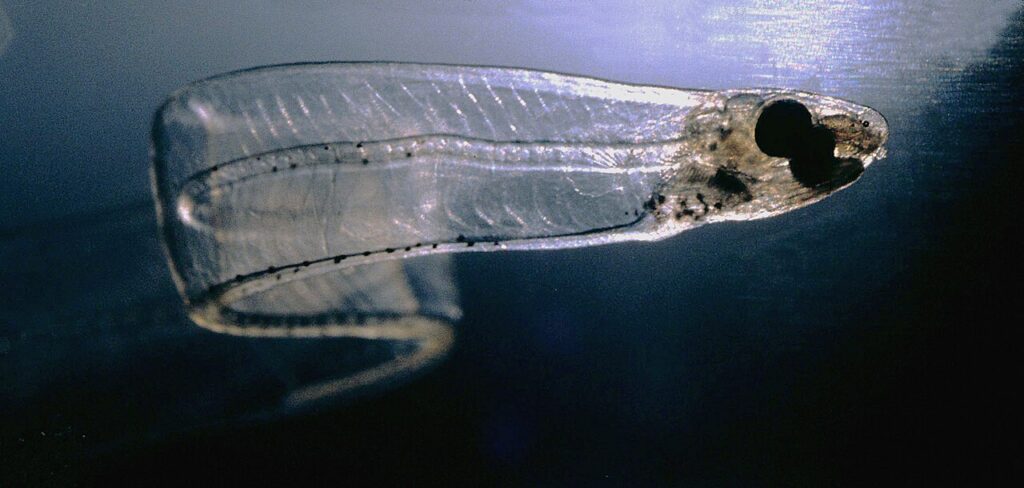
Young eels enter European waters as transparent, leaf-shaped larvae carried by ocean currents. As they approach the continental shelf, they transform into glass eels, then develop pigmentation and become elvers. They move into freshwater or remain in brackish coastal environments, where they may live for years before changing into silver eels and beginning their seaward migration.
This transition involves more than a change in appearance. Silver eels develop traits suited to a long ocean journey, including larger eyes and physiological changes associated with migration. They stop feeding as they leave inland habitats, relying on energy reserves accumulated during their growth. The journey is demanding, but the route is not a single, simple channel: eels depart from widely separated locations and encounter different currents, coastlines, and human-made obstacles.
What researchers can—and cannot—track
Electronic tags have helped researchers learn how migrating eels move through the ocean. Tracking results indicate that some travel at considerable depths and that their routes can be affected by currents. But tags do not provide a continuous record for every animal. A tag may stop transmitting, detach, or yield only intermittent locations, leaving gaps precisely where observations are most valuable.
Finding larvae offers a different kind of evidence. Their distribution can help researchers estimate where spawning occurs and how currents disperse the young. Smaller larvae tend to be found closer to the presumed breeding region, while larger ones occur farther away. This pattern supports the connection between the Sargasso Sea and eel reproduction, but it does not reveal the exact place, depth, or behavior involved in spawning.
The missing observations
Adult European eels have rarely been observed spawning in the open ocean. The animals may reproduce at depths or under conditions that make direct observation difficult. Their long migration also spreads the search across a vast area, while the relevant season and duration of spawning remain challenging to pin down.
There are practical limits, too. Researchers cannot easily follow a large number of eels from different European rivers all the way to the breeding region. Ocean currents complicate route prediction, and the deep sea is costly to survey. Even when a tagged eel reaches the wider area, its location alone cannot show whether it has spawned or what environmental cues guided it.
These gaps matter because the eel’s reproductive cycle is tightly linked to population survival. The species has declined sharply in recent decades, and barriers to migration, habitat change, fishing, pollution, and other pressures can affect different stages of its life. Understanding where and how reproduction occurs could improve conservation planning, though no single discovery would resolve all the factors behind the decline.
Why the cycle remains a scientific puzzle
The eel’s life cycle spans continents and multiple habitats, so evidence is divided among oceanography, ecology, and fisheries research. A pattern in larval distribution can suggest a breeding area; a tag can show a route; a change in body condition can indicate preparation for migration. None of these observations alone supplies a complete account.
Researchers also have to distinguish between what is strongly supported and what remains inferred. The Sargasso Sea is central to the accepted account of European eel reproduction, but the precise spawning site and the sequence of events there have not been observed in the same way that spawning can be studied in accessible animals. That distinction keeps the mystery focused: it is not whether eels migrate across the Atlantic, but what happens at the end of that migration.
A clearer outline, not a final answer
New tracking methods, improved ocean models, and systematic sampling of larvae may gradually narrow the remaining uncertainties. Combining these approaches is more useful than expecting a single tag or expedition to settle the question. Each can test a different part of the journey, from departure conditions to the distribution of newly hatched larvae.
For now, the European eel’s story is partly mapped and partly hidden. Scientists can describe its transformation from freshwater resident to ocean migrant and identify the broad region linked to reproduction. They still lack a direct, detailed view of the final journey and spawning itself. The mystery persists not because there is no evidence, but because the evidence is scattered across an enormous and difficult-to-observe ocean.