For centuries, humanity has gazed into the night sky and confronted a haunting question: Are we alone? The concept of the "alien" occupies a unique threshold in modern thought, existing simultaneously as a persistent cultural archetype, a canvas for human psychological anxiety, and one of the most formidable frontiers of contemporary empirical science. While popular culture often populates the cosmos with humanoid visitors and flying saucers, the scientific reality of extraterrestrial investigation has matured into a disciplined, data-driven quest spanning astrophysics, planetary chemistry, and evolutionary biology.
To explore the alien question requires navigating two distinct yet deeply intertwined narratives: the history of how human societies projected their deepest fears and aspirations onto the void, and the rigorous methodologies currently deployed to detect whether biological processes have occurred elsewhere in the universe.
1. Cultural Projections and the Cold War Mythos
The contemporary image of the extraterrestrial did not emerge in a vacuum; it crystallized alongside mid-twentieth-century industrialization and the dawn of the nuclear era. Although ancient philosophy debated the multiplicity of worlds—from the atomists of ancient Greece to Renaissance cosmologists—the modern "alien" emerged primarily during the mid-20th century.
The post-World War II period saw an explosion in reported sightings of unidentified flying objects (UFOs), coinciding precisely with the dawn of the space race, the deployment of radar networks, and pervasive nuclear anxieties. In this context, aliens served as an externalized manifestation of human vulnerability. They were envisioned either as technologically omnipotent conquerors mirroring geopolitical adversaries, or as enlightened cosmic arbiters arriving to caution humanity against self-annihilation.
"Our depictions of alien civilizations often reveal far more about our terrestrial anxieties, technological hubris, and social divisions than they do about the physical realities of the cosmos."
Science fiction during this era bridged the gap between popular folklore and speculative engineering. Authors and filmmakers popularized concepts such as interstellar travel, telepathy, and planetary colonization. While these narratives stimulated public curiosity and inspired generations of scientists, they also cemented sensationalist tropes that frequently obscured the actual physical constraints governing space exploration.
2. The Theoretical Dilemma: Fermi’s Paradox and the Great Filter
Moving from cultural imagination to theoretical astrophysics, the scientific contemplation of extraterrestrial intelligence gained formal footing through mathematics and probabilistic modeling. In 1961, astronomer Frank Drake formulated what is now known as the Drake Equation, a probabilistic framework designed not to provide a definitive answer, but to stimulate structured dialogue regarding the variables involved in the emergence of communicative civilizations.
The Drake Equation examines factors including:
- The average rate of star formation in our galaxy;
- The fraction of those stars possessing planetary systems;
- The number of planets capable of sustaining life per system;
- The probability of life developing, evolving intelligence, and creating detectable technology;
- The longevity of such technological civilizations.
As astronomers discovered thousands of exoplanets over the last three decades, several variables in the Drake Equation shifted from speculative guesses to established empirical values. We now know that planetary systems are common rather than anomalous. This realization intensifies the famous paradox attributed to physicist Enrico Fermi: If planetary systems capable of hosting life are abundant across billions of years of cosmic history, where is everybody?
The apparent tension between statistical probability and empirical silence has yielded dozens of theoretical resolutions. Among the most sobering is the "Great Filter" hypothesis, which suggests that an evolutionary barrier prevents prebiotic chemistry from achieving long-term interstellar communication. Whether this filter lies behind us—in the form of the exceedingly rare transition from non-living matter to complex multicellular life—or ahead of us, in the form of technological self-destruction, remains one of modern cosmology’s most critical unresolved questions.
3. Astrobiology and the Hunt for Biosignatures
While theoretical physics contemplates galactic civilizations, astrobiology grounds the alien inquiry in laboratory chemistry and planetary geology. Modern researchers have largely moved beyond searching exclusively for advanced civilizations, focusing instead on the far more probable presence of microbial life or distinct geochemical imbalances known as biosignatures.
This shift in methodology has been heavily influenced by the study of extremophiles on Earth. Organisms discovered thriving in boiling hydrothermal vents, hyper-saline lakes, radiation-rich environments, and subglacial lakes in Antarctica have fundamentally broadened our understanding of environmental habitability. If life can thrive under terrestrial extremes once considered barren, the environmental envelopes of other planetary bodies become viable biological candidates.
- Mars: Subsurface investigations continue to assess ancient sedimentary basins and underground water pockets that may preserve fossilized microbial remnants or active chemosynthesis.
- Europa: Jupiter’s ice-covered moon harbors a vast subsurface liquid ocean, kept warm by tidal heating, presenting an environment chemically suitable for biotic chemistry.
- Enceladus: Saturn’s moon expels plumes of water vapor containing organic molecules, silica nanoparticles, and molecular hydrogen directly into space, offering accessible samples of a subsurface hydrothermal environment.
- Titan: With its dense atmosphere and surface lakes of liquid methane and ethane, Titan represents a natural laboratory for exploring pre-biotic chemistry unlike anything found on Earth.

4. Technological Frontiers: SETI, Spectroscopy, and Machine Learning
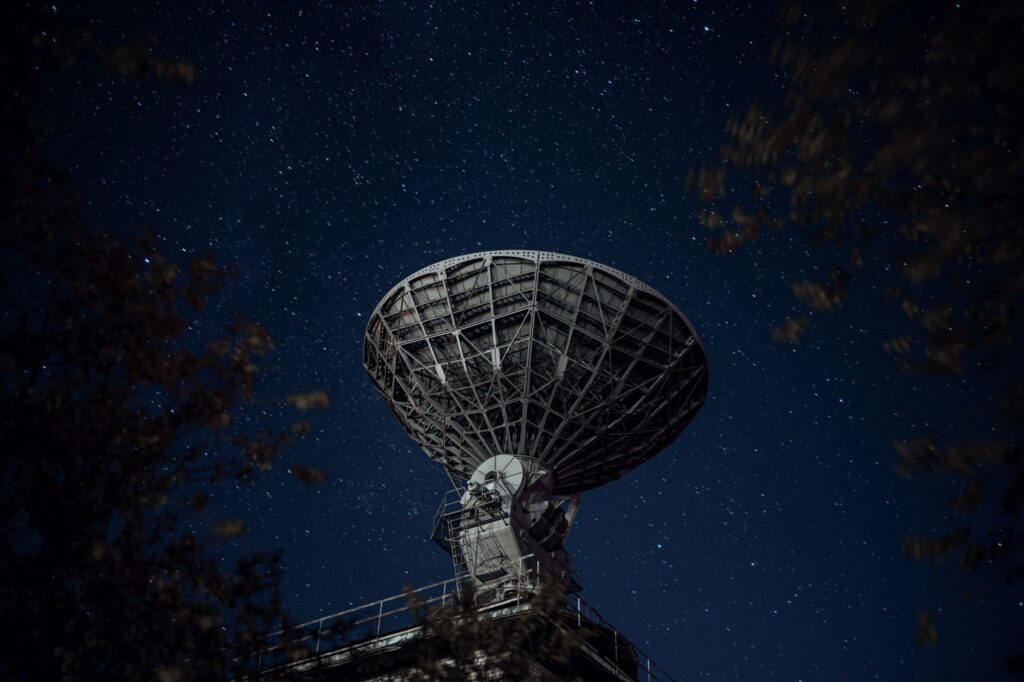
The contemporary detection of extraterrestrial phenomena relies on instruments operating across the electromagnetic spectrum. The Search for Extraterrestrial Intelligence (SETI) has evolved from narrow radio telescope observations into automated, wide-field sky surveys monitoring both radio frequencies and optical laser pulses.
Concurrently, deep-space observatories like the James Webb Space Telescope (JWST) have transformed the characterization of exoplanetary atmospheres. Through transmission spectroscopy—measuring the minute fraction of starlight that filters through a planet’s atmospheric veil—scientists can determine the chemical compositions of worlds dozens or hundreds of light-years away.
Researchers look specifically for atmospheric disequilibrium: combinations of gases, such as methane and oxygen, that rapidly neutralize each other unless continually replenished by active biological or geochemical engines. Detecting an atmosphere out of chemical equilibrium, paired with specific volatile ratios, would provide the strongest indirect evidence of life outside our solar system.
Furthermore, the sheer volume of observational data produced by astronomical sky surveys has outpaced manual human analysis. Modern initiatives increasingly deploy artificial intelligence and deep-learning algorithms to scan petabytes of radio recordings and optical spectra. Machine learning models identify subtle anomalies, filter out terrestrial radio frequency interference, and detect non-random signals that traditional statistical methods might miss.
5. The Philosophical and Societal Impact of Discovery
The confirmation of any extraterrestrial life-form—even a single fossilized microorganism on Mars or an anomalous atmospheric reading from an exoplanet—would trigger a profound intellectual revolution. The discovery would conclusively end human cosmic isolation and transform biology from a parochial science based on a single sample (terrestrial life) into a truly universal discipline.
Sociologists, theologians, and policy analysts have long analyzed post-detection scenarios. While historical narratives assumed panic or existential despair, modern sociological consensus suggests responses would vary across cultural, scientific, and geopolitical lines. The primary challenge would likely not be fear, but interpretation: distinguishing between ambiguous geochemical data and definitive biological proof requires years of scientific consensus-building.
Ultimately, the search for the alien serves as an enduring mirror. By articulating what alien life might look like, how it might communicate, and what challenges it must overcome to survive, humanity defines its own position in the cosmos. Whether the outcome of our search reveals an ocean teeming with extraterrestrial microbes or confirms a silence that underscores the extraordinary rarity of life on Earth, the quest fundamentally enhances our appreciation for the fragile, interconnected biosphere we inhabit.