A report from the outskirts of Socorro
On April 24, 1964, Lonnie Zamora, a police officer in Socorro, New Mexico, was pursuing a speeding car when a loud noise and a flame-like shape caught his attention. He left the road to investigate. What followed became one of the best-known close-encounter reports in the United States—not because it proved alien contact, but because Zamora was a named, local witness and investigators examined the location soon after.
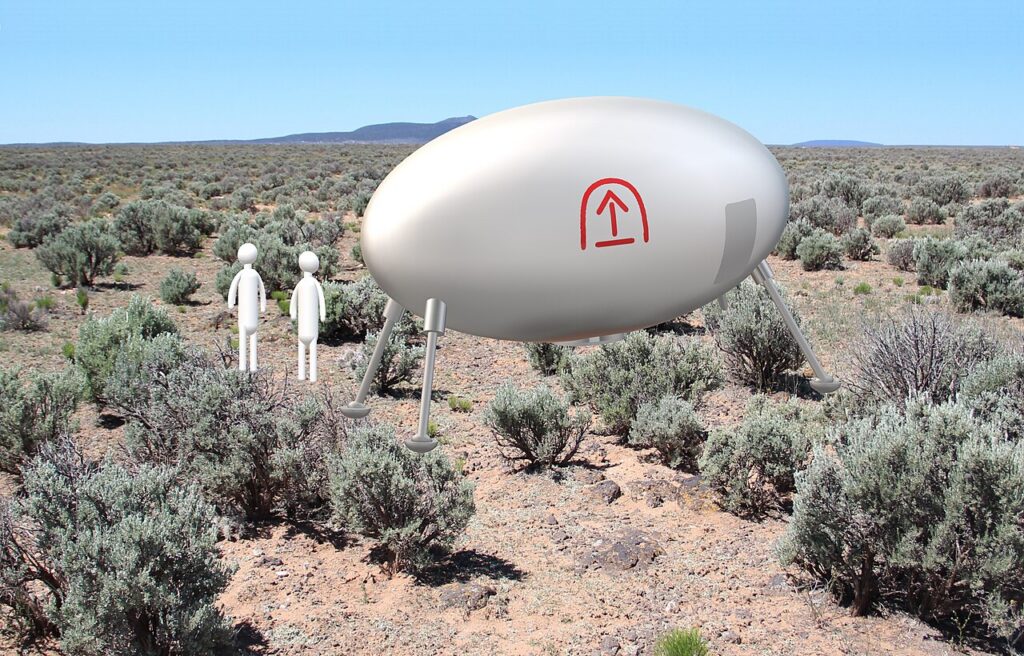
Zamora said he saw an oval object on the ground near a small, isolated structure. He described two small figures beside it, wearing light-colored clothing. When one appeared to notice him, the figures moved toward the object. Zamora reported that it rose, made a loud noise, and departed, leaving him with the impression that it had flown away at speed.
What investigators found at the site
The reported landing area was not simply an empty stretch of desert. Investigators noted marks in the soil and signs consistent with something having rested or pressed against the ground. Zamora also described seeing a red symbol on the object. These details made the account more specific than a distant light in the sky, but they did not identify what had been there or explain how it moved.
Members of the Air Force’s Project Blue Book, the program then responsible for examining UFO reports, interviewed Zamora and visited the area. Their work included considering ordinary explanations and checking whether the account might have been a hoax. Zamora was generally regarded by investigators as sincere, but sincerity is not the same as an accurate identification: a person can report an experience honestly and still be mistaken about its cause.
The physical traces were also limited evidence. Marks in soil can support the claim that something disturbed the ground, yet they cannot by themselves establish that a craft landed. Without a known object, clear photographs, or independently documented biological evidence, the site could not settle the central question of what Zamora had seen.
Why the case attracted attention
Several features helped the report endure. Zamora was a serving police officer, not an anonymous caller, and he reported the event promptly. The location was accessible to investigators, and the description included details that could be recorded and compared. A nearby witness reported hearing a loud noise, though the available accounts did not independently confirm every part of Zamora’s observation.
Those strengths have limits. A credible witness can still misperceive an unfamiliar event, especially one that unfolds quickly and under stressful conditions. A second person hearing a sound may corroborate that something unusual occurred without confirming the identity or appearance of its source. The evidence is therefore best separated into layers: what Zamora reported, what investigators observed afterward, and what later accounts inferred from both.
Explanations and unanswered questions
Project Blue Book did not establish a definitive identification. Various explanations have been proposed over the years, including a conventional vehicle or an experimental craft, but proposals are not confirmed findings. The available public record does not demonstrate that the object was extraterrestrial, nor does it provide enough information to reconstruct every moment of the encounter with confidence.
That distinction matters. Calling the report an “alien contact incident” describes a later interpretation, not a conclusion supported by the investigation. The figures in Zamora’s account are part of his testimony; there is no independently verified evidence that they were visitors from another world. Likewise, the object’s reported departure does not reveal its design, origin, or means of propulsion.
What the Socorro incident can—and cannot—show
The Socorro case remains useful as a study in how to assess a striking claim. Investigators had a witness to interview and a location to inspect, giving them more to work with than a report of an unidentified light. At the same time, the traces were not uniquely diagnostic, and the event left no publicly confirmed artifact that could resolve competing explanations.
More than a memorable story, the incident illustrates the difference between documenting an unusual experience and proving its cause. Zamora’s report remains a significant historical UFO case because it was specific and investigated. Whether it represented an encounter with an extraordinary aircraft, a misidentified event, or something else remains unresolved by the evidence available.