On August 15, 1977, a radio telescope in Ohio recorded a brief, unusual signal from the sky. It lasted just 72 seconds in the instrument’s data, but its distinctive pattern soon gave it a memorable name: the Wow! signal. Nearly five decades later, it remains one of the most discussed events in the search for possible extraterrestrial intelligence—not because it proved contact, but because its origin has never been settled.
A signal in the Big Ear data
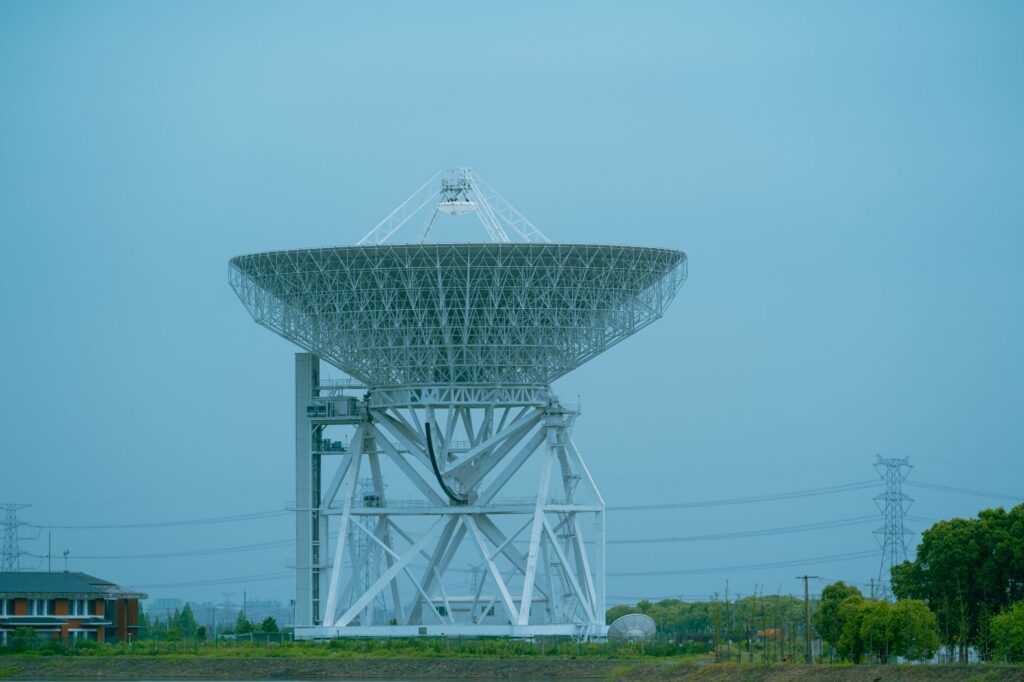
The observation came from Ohio State University’s Big Ear radio telescope, which was conducting a sky survey connected with the search for signals that might come from an intelligent source. Big Ear did not work like a dish that could be pointed and held on one target. As Earth rotated, the telescope scanned the sky, and its receiver monitored radio frequencies.
The signal appeared near 1420 megahertz, a frequency associated with neutral hydrogen. That made it scientifically interesting: hydrogen is abundant throughout the universe, and the frequency has long attracted attention in discussions of how a distant transmitter might be noticed. The frequency alone, however, does not identify a signal’s source or establish that anyone deliberately transmitted it.
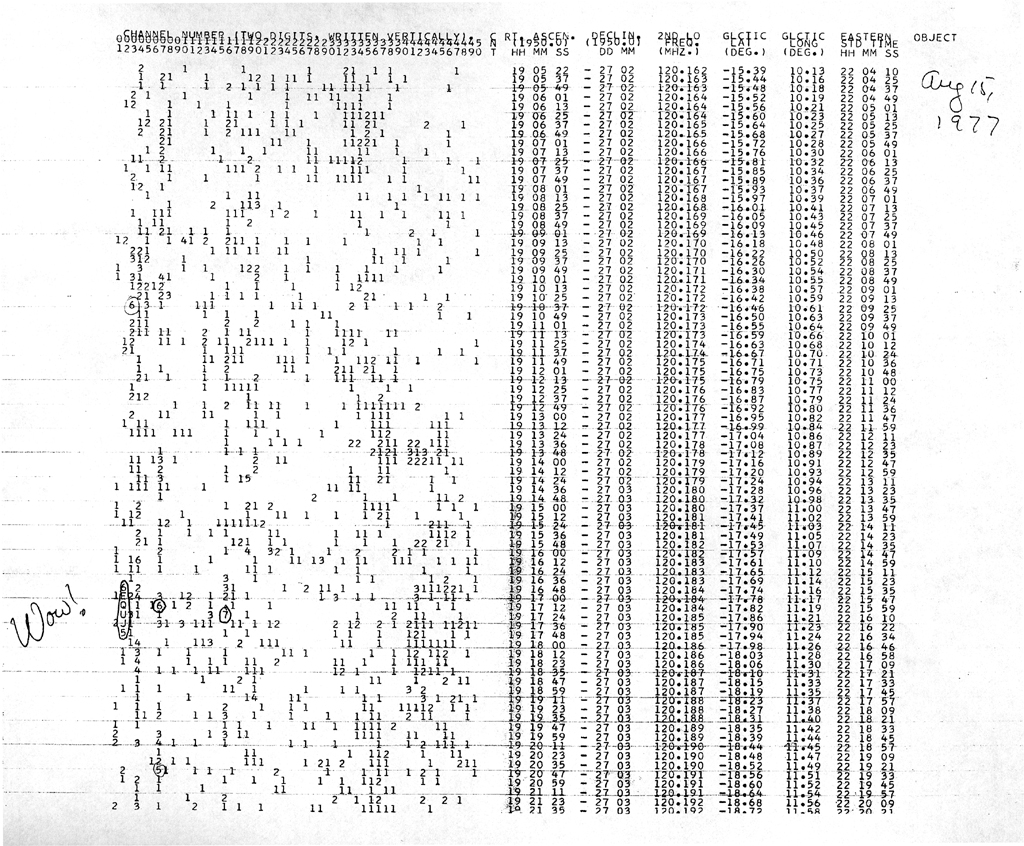
The telescope’s computer printed measurements as a sequence of letters and numbers. When astronomer Jerry Ehman reviewed the printout, he circled the sequence “6EQUJ5” and wrote “Wow!” beside it. The notation represented the signal’s changing intensity, not a decoded message. Its rise and fall matched the pattern expected when a steady source passed through the telescope’s fixed field of view.
Why the observation stood out
Several properties made the event worth investigating. It was much stronger than the ordinary background recorded in that part of the survey, appeared in a relatively narrow band, and was detected close to the hydrogen line. Its duration also fit the time Big Ear would take to scan across a fixed point in the sky.
That last detail is important, but it is not proof of an extraterrestrial origin. A telescope’s motion can help researchers test whether a signal behaved like a celestial source, yet an observation can still be affected by interference, instrumental effects, or an unusual natural source. Determining which explanation applies requires evidence that can be checked independently.
Big Ear’s observing arrangement provided a useful opportunity for confirmation. It used two feed horns that viewed the sky in succession. A persistent source in the sky would ordinarily be expected to appear in both observations. The signal was recorded in only one. That does not rule out a celestial origin, since a source could vary or circumstances could differ between the observations, but it leaves researchers without the kind of repeat detection that would make the case stronger.
The missing evidence
Follow-up searches did not find the signal again. Without a repeat, astronomers could not measure whether its frequency drifted over time, track a changing source, or obtain a second observation from another telescope. Nor did the printout contain words, numbers, or an unmistakable pattern that could be treated as a message. “6EQUJ5” is simply the recorded intensity sequence.
Researchers have considered explanations involving terrestrial interference and possible astronomical sources, but no explanation has become a confirmed account of the event. The gap between “unexplained” and “evidence of extraterrestrial intelligence” is substantial. A signal can be unusual without being artificial, and even an artificial signal would not by itself reveal who produced it or whether it was intended for Earth.
What a first detection would need
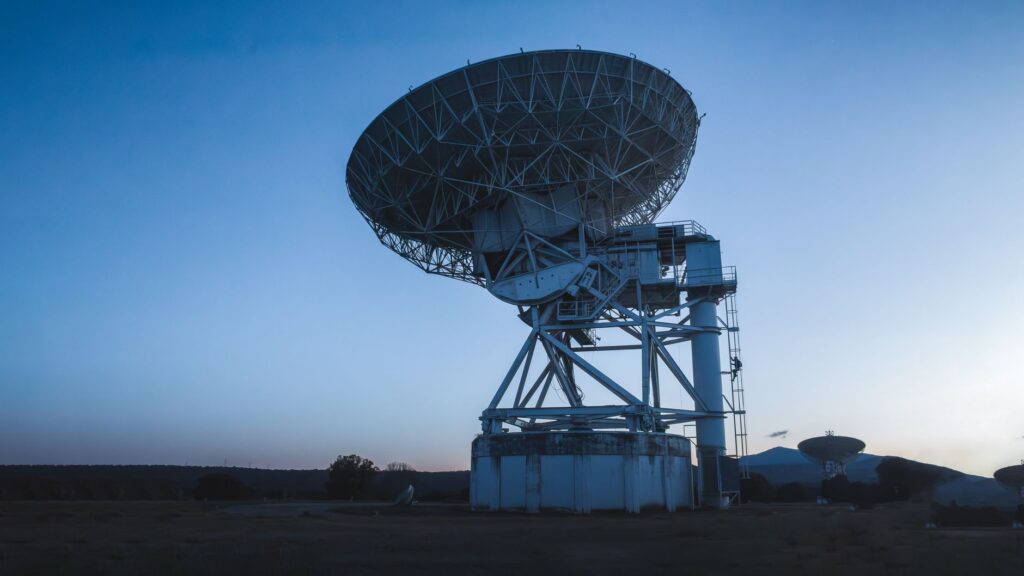
The Wow! signal is best understood as an intriguing, unverified observation. It prompted attention because it had features worth checking, but the limited record prevents a confident conclusion. In the search for an actual technological signal, researchers would want independent observatories to detect the same event, careful checks for local interference, and enough data to characterize its frequency, duration, and position.
Those standards are not a dismissal of the 1977 observation; they explain why it remains open. A repeated signal, confirmed from separate instruments and consistent with a source in the sky, would transform the discussion. The Wow! signal did not meet that threshold. Its lasting significance lies in the question it leaves behind: a striking trace appeared once in a telescope’s data, and the evidence needed to identify its source never arrived.