A red stream in a frozen landscape
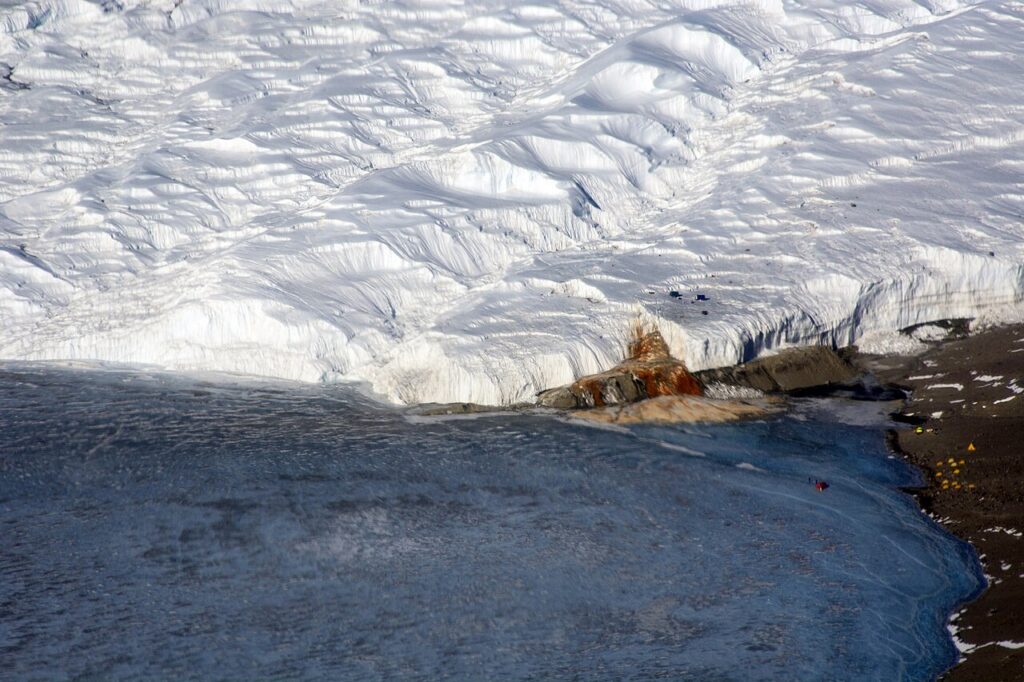
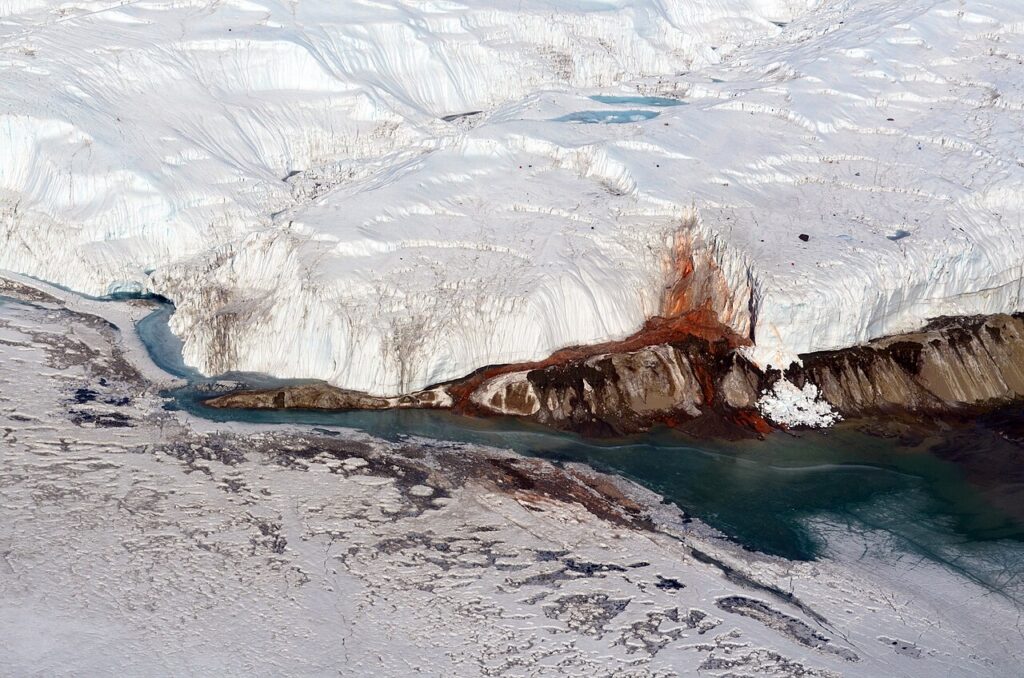
At the edge of Taylor Glacier in Antarctica’s McMurdo Dry Valleys, a vivid red stain marks the ice where a salty liquid seeps out. Known as Blood Falls, the feature appears startling against the glacier’s pale blue surface and the barren, snow-dusted ground. The color has a chemical explanation: iron in the brine oxidizes when it meets air, producing reddish compounds much as iron rusts.
That explanation resolves the most obvious visual mystery, but not the whole one. The liquid is unusually salty, remains mobile in extreme cold, and emerges from a glacier whose interior is hard to observe. Researchers have mapped important parts of the system, yet the routes and conditions that sustain its discharge are not fully understood.
How the water stays liquid
Ordinary freshwater freezes well below the temperatures typical of this Antarctic valley. Salts lower water’s freezing point, allowing concentrated brine to remain liquid under conditions that would turn a less saline stream to ice. The brine at Blood Falls is also rich in iron, which accounts for the change in color after exposure to oxygen.
The source is associated with a saline reservoir beneath Taylor Glacier. Evidence indicates that the brine moves through cracks and channels within the ice before reaching the surface. Its journey is not a simple open stream: glacier ice can seal pathways, shift under pressure, and fracture, making the internal plumbing difficult to trace directly.
Researchers have used geophysical measurements, including radar observations, to investigate the glacier and the water beneath it. Such methods can reveal structures hidden from view, but they do not provide a continuous picture of every channel or explain precisely when and how brine travels through them. Each observation captures only part of a dynamic system.
A reservoir with a long history
The brine is thought to have been isolated beneath the glacier for a very long time. Its high salinity and unusual chemistry distinguish it from surface meltwater, which is scarce in the dry valley environment. The reservoir’s isolation raises questions about how it formed, how its volume changes, and what processes keep it connected to the falls visible today.
One challenge is that the source cannot simply be sampled like a lake or river. Drilling or excavation could alter the pressure, temperature, and microbial conditions that investigators are trying to understand. Scientists therefore rely on measurements at the outlet and on remote observations, combining clues rather than opening the system for direct inspection.
The discharge itself appears episodic rather than a steady, easily measured flow. Ice movement, pressure changes, and the geometry of hidden passages may all influence when brine reaches the surface. The relative importance of those factors remains an active question, and the limited access to the subglacial environment makes long-term monitoring especially valuable.
Microbes in a dark, salty habitat
Blood Falls has also drawn attention because the brine supports microbial life in conditions with little or no sunlight. The organisms obtain energy through chemical reactions involving compounds available in the brine and surrounding minerals. This is not evidence that life can flourish anywhere; it is a specific ecosystem shaped by liquid water, concentrated salts, and a supply of usable chemical energy.
Studying that ecosystem helps researchers examine how microbes survive in cold, dark environments. It also offers a useful comparison for thinking about potentially habitable places beyond Earth, such as icy worlds where liquid water may exist beneath a frozen surface. The comparison is limited: conditions on another world would need to be measured rather than assumed to resemble Antarctica.
Sampling is technically demanding. Researchers must distinguish organisms that genuinely inhabit the brine from material introduced during collection or analysis. Careful handling and contamination controls matter because the expected biological signals can be subtle, and the surrounding Antarctic environment is itself part of the scientific question.
What remains unresolved
Blood Falls is no longer a mystery because it looks like blood; its red appearance follows from iron chemistry. The deeper puzzle is how a hidden, saline reservoir is maintained beneath moving ice and how its water finds a path to the surface. The timing of discharge, the detailed arrangement of internal channels, and the history of the brine remain difficult to establish.
Future work will depend on combining observations gathered over time: measurements of the outlet, improved views of structures beneath the glacier, and carefully controlled analysis of the brine and its microbes. No single instrument can answer every question. Together, these approaches can narrow the possibilities without disturbing a fragile system more than necessary.
Blood Falls is a small opening into a concealed Antarctic environment. Its striking color is the visible end of a process involving salt, iron, ice, and living organisms—a reminder that even in a landscape that appears empty, hidden systems can persist beyond easy observation.