Understanding the Modern AI Paradigm
Artificial intelligence has transitioned from theoretical exploration to an infrastructural cornerstone of contemporary computing. While early iterations relied heavily on rule-based heuristics and hand-engineered feature representations, the field has undergone a decisive transformation toward data-driven representation learning. The modern AI paradigm is defined not merely by algorithmic ingenuity, but by the convergence of scalable architectures, specialized hardware accelerators, and massive parameter optimization.
At the center of this shift is the transformer architecture, introduced in 2017. By replacing sequential recurrent mechanisms with self-attention layers, transformers enabled unprecedented parallelization across distributed clusters. This architectural breakthrough removed previous computational bottlenecks, allowing models to process context windows encompassing tens of thousands of tokens simultaneously. Consequently, the industry witnessed the emergence of foundation models—broad neural networks trained on vast, uncurated data distributions capable of adapting to diverse downstream tasks through zero-shot and few-shot prompting.
As these models scale, their capabilities exhibit emergent behaviors. Competencies in syntactic parsing, multi-step logical deduction, and semantic summarization develop organically as side effects of next-token prediction objectives. However, scaling parameters alone presents diminishing returns without qualitative architectural refinements, rigorous data curation, and post-training alignment techniques.

From Isolated Modalities to Native Multimodal Systems
Early deep learning systems treated sensory inputs in isolation. Computer vision pipelines leveraged convolutional networks for feature extraction, while natural language processing relied on recurrent networks or transformers trained strictly on text corpora. Bridging these domains historically required composite architectures: passing an image through an optical character recognition or image-tagging layer, translating results into text strings, and processing those strings through a language model.
Modern multimodal systems dismantle these artificial boundaries. Instead of piping outputs through disparate modules, state-of-the-art multimodal models are trained natively across multiple data types. High-resolution imagery, spoken audio waveforms, structured video streams, and text tokens are projected into a shared high-dimensional embedding space. This architectural unification yields several technical advantages:
- Cross-modal reasoning: The model directly interprets spatial relationships, acoustic nuances, and visual contexts without information loss caused by intermediate text translation.
- Reduced latency: Eliminating multi-model handoffs simplifies the inference pipeline, allowing real-time processing of streaming audio and visual feeds.
- Holistic comprehension: Visual and acoustic data enrich conceptual representations, grounding linguistic concepts in real-world physical and perceptual dynamics.
By treating distinct modalities as homogeneous sequences of tokens, modern architectures establish an intuitive computational continuum where perception and reasoning occur synchronously within a single neural substrate.
The Infrastructure Behind Scalable Intelligence
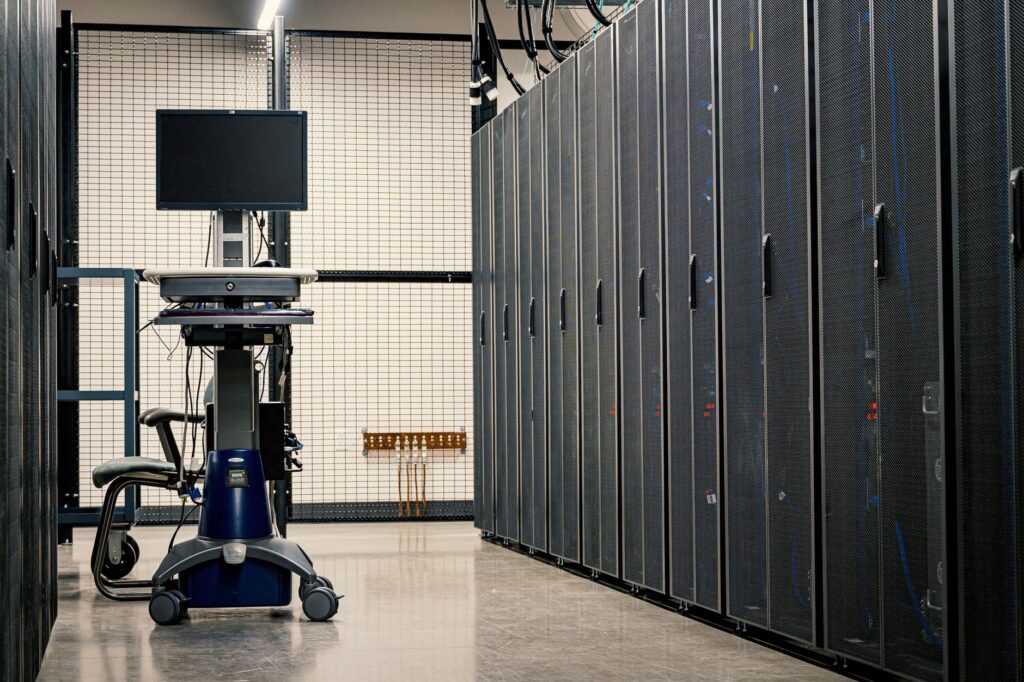
Behind the conceptual elegance of modern machine learning lies an intricate web of low-level systems engineering, distributed computation, and physical infrastructure. Training a state-of-the-art foundation model requires tens of thousands of specialized accelerators—such as Graphics Processing Units (GPUs) or Tensor Processing Units (TPUs)—operating in concert across high-bandwidth optical fabrics.
To overcome memory bottlenecks and communication latency, researchers and infrastructure engineers rely on sophisticated parallelism strategies:
- Tensor Parallelism: Splitting individual weight matrices across multiple computing units to execute matrix multiplications concurrently.
- Pipeline Parallelism: Distributing different sequential layers of the network across separate devices, managing activation pipelines to minimize idle processor cycles.
- Data Parallelism and Sharding: Partitioning optimizer states, gradients, and model parameters across cluster nodes using techniques like Zero Redundancy Optimizer (ZeRO) implementations.
Beyond training, the economics of production inference have made deployment optimization a primary engineering challenge. Techniques such as 4-bit and 8-bit weight quantization, flash attention algorithms, and speculative decoding dramatically lower the floating-point operations (FLOPs) and video memory required per token generated. As organizations integrate models into latency-critical environments, edge computing and on-device model architectures are rapidly closing the efficiency gap.

Operationalizing AI: Agents, RAG, and Workflow Automation
While base foundation models showcase impressive general capabilities, enterprise utility depends on deterministic execution, data recency, and domain-specific precision. A standalone language model remains bounded by the cutoff date of its training corpus and susceptible to hallucinations when queried on private institutional data.
To bridge the gap between static model weights and dynamic production systems, software engineering has shifted toward compound AI systems. Rather than relying solely on the neural network to store knowledge, architectures incorporate external orchestration layers:
- Retrieval-Augmented Generation (RAG): By interfacing neural models with high-dimensional vector databases and traditional keyword indexes, RAG pipelines dynamically extract relevant documents from enterprise repositories, supplying verified contextual data directly into the prompt payload.
- Tool Calling and Function Execution: Modern models are trained to emit structured outputs, such as JSON-formatted API calls, enabling them to query SQL databases, fetch live web endpoints, or interface with enterprise resource planning tools.
- Autonomous Agentic Workflows: Instead of simple single-turn interactions, modern applications structure AI into recursive execution loops. Models formulate plans, execute intermediary commands, critique the resulting outputs, and refine their actions iteratively until the target objective is achieved.
Engineering modern AI is no longer just about training larger models; it is about building resilient software harnesses, verification guardrails, and deterministic evaluation loops around non-deterministic computational engines.
Technical Bottlenecks and Future Trajectories
Despite rapid advances, systemic challenges remain embedded in modern artificial intelligence. Hallucination—the generation of factually incorrect yet grammatically coherent assertions—persists as a fundamental artifact of probabilistic token modeling. Because the objective function optimizes for likelihood under an inferred training distribution rather than absolute truth, ensuring epistemic reliability remains an active field of research.
Furthermore, training compute requirements continue to test physical infrastructure, consuming substantial electric power and straining thermal dissipation capacities in modern datacenters. In response, algorithmic research is pivoting toward data-centric engineering: using synthetic data generation, rigorous filtering heuristics, and smaller, curated datasets to achieve performance parity with vastly larger, unrefined models.
As artificial intelligence shifts from experimental novelty to ubiquitous computational infrastructure, the focus across research laboratories and software engineering teams has consolidated. The next frontier belongs to energy-efficient architectures, provably aligned agentic frameworks, and integrated multimodal systems that interact reliably with the physical world.